Ecological restoration at Bamff has been underway since the early 1990s, beginning with wetland recreation, native woodland planting and – most significantly – the introduction of beaversin 2002. The Bamff Wildland Project is the next chapter: an ambitious, long-term commitment to return approximately 170 hectares of marginal farmland and plantation to self-willed land.
The Wildland area occupies the southern third of the estate, sitting at around 600–700 feet above sea level on the Highland edge. It is a varied, undulating terrain – roughly half open fields, historically used for sheep pasture and fodder crops, and half woodland of mixed character, from exotic conifer plantations to native hardwoods.
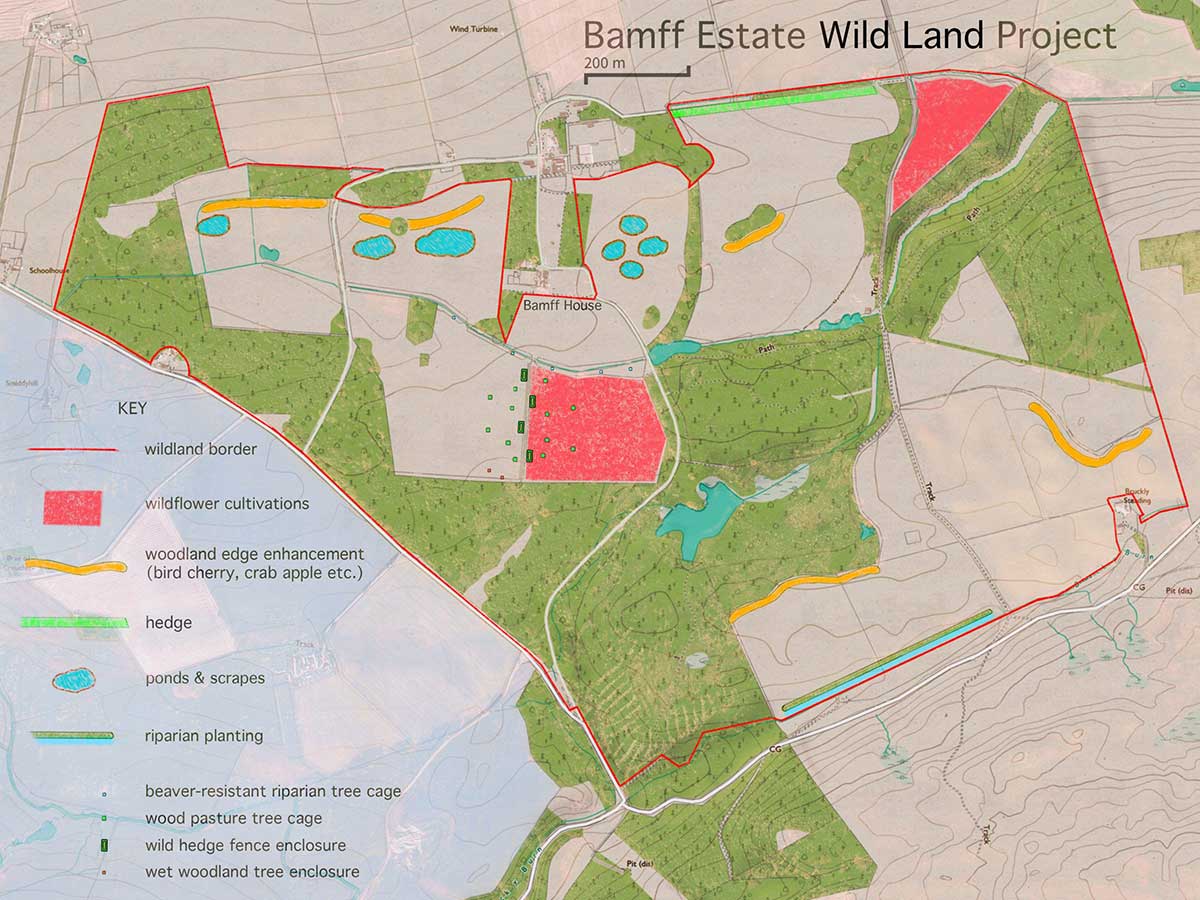
The long-term vision is a self-regenerating mosaic of habitats and wildlife, with human management gradually withdrawn as ecological processes take hold. But given the urgency of the biodiversity crisis, we are not simply standing back and waiting. From the outset, targeted interventions have been used to accelerate natural recovery: ponds and scrapes dug for wetland species, native trees and thorny scrub planted to extend habitat corridors, wildflower areas established, bat houses and hibernacula installed, invasive non-native species removed. These actions are designed to give struggling species a foothold while the wider landscape finds its own direction.
old conservation management map - with satellite imagery
A list of actions:
Digging ponds and scrapes for wetland birds and other species.
Planting native trees (oak, hazel, crab apple, holly).
Planting hedges of thorny scrub (blackthorn, hawthorn, wild rose),
Planting riparian trees near waterways.
Planting many acres of wildflowers.
These extend biological corridors and help to inter-connect habitat, improving the breeding and feeding grounds for many native species including, we hope, vulnerable ones, lost to our land in recent years, such as lapwing and curlew.
Bat houses are being installed across the area to increase bat breeding and survival.
Hibernacula is being created for a range of species, including bats, hedgehogs and amphibians.
Invasive non native species are gradually being removed.
Nesting boxes have been installed for a range of vulnerable birds.
These all give a boost to many struggling native species and increase their chances of survival.
The three beaver families already present on the land have created an extensive area of wetlands, consisting of around sixty dams and pools with their associated fallen and drowned trees, coarse woody debris in the water, and coppiced stems. This has already begun the process of catalysing the rewilding of this land in the riparian zone.
Many wetland species have already benefited from this and every year more new species appear in the riparian zone and beyond. Common species also occur in ever greater abundance.
As an important first step, sheep were removed at the end of 2020. Since 2022, the perimeter-fenced wildland has been grazed at low density by Luing cross cattle, Tamworth pigs, and since 2024, Exmoor ponies – each species bringing distinct ecological behaviours that mimic the primitive grazing relationships that once shaped upland Scotland. Their impact on ground structure, vegetation and seed dispersal is already visible across the fields.
Running through it all, the beavers continue their own work. Three family groups have built dozens of dams and pools across the riparian zone, fundamentally altering the hydrology and driving a cascade of habitat change that no human intervention could replicate or accelerate.
The project is being systematically monitored – tracking vegetation change, species presence, soil health and carbon – creating a documented demonstration of rewilding in the Scottish uplands that can inform and inspire others.
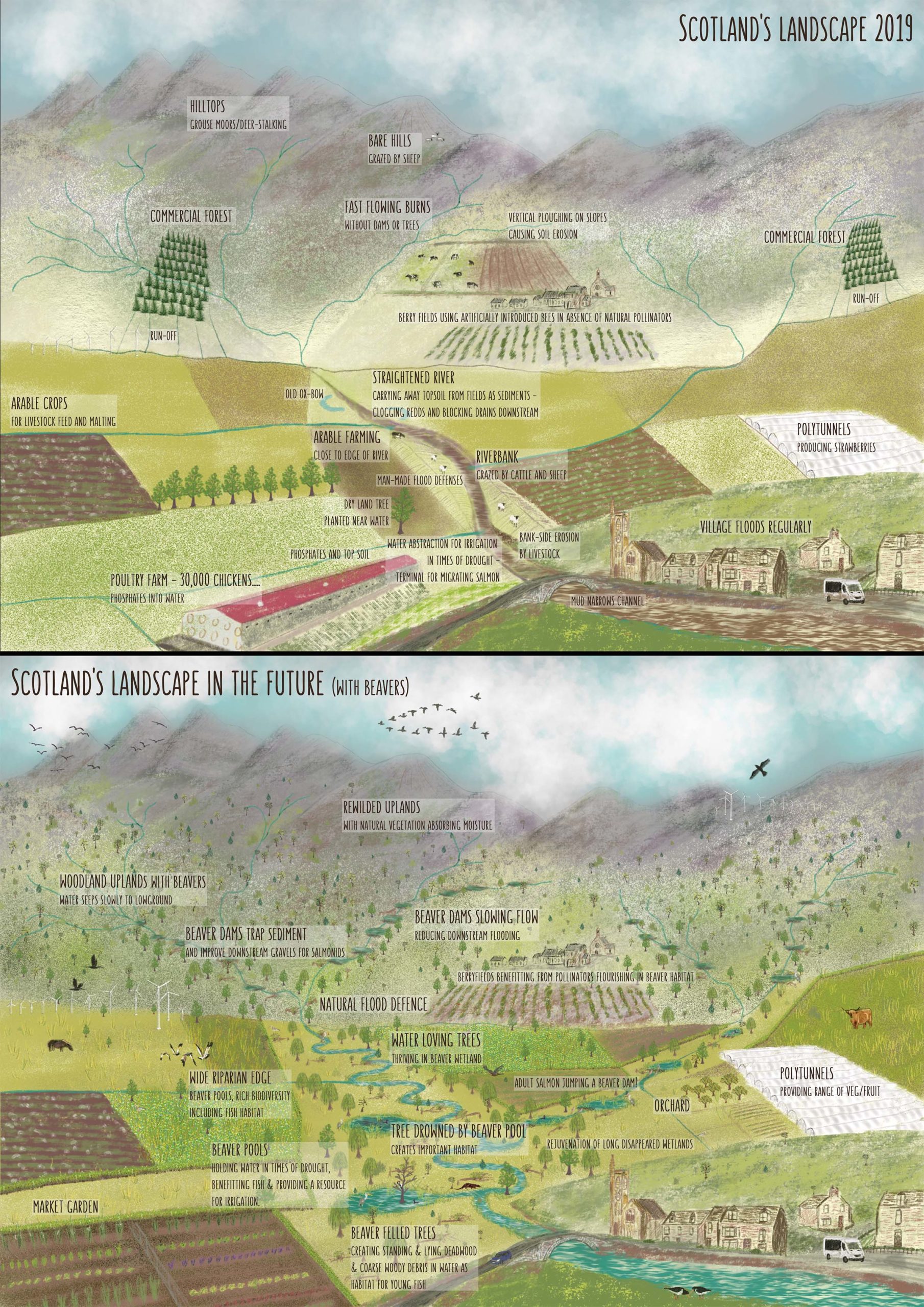
poster from 2019 depicting rewilding in Scottish uplands